
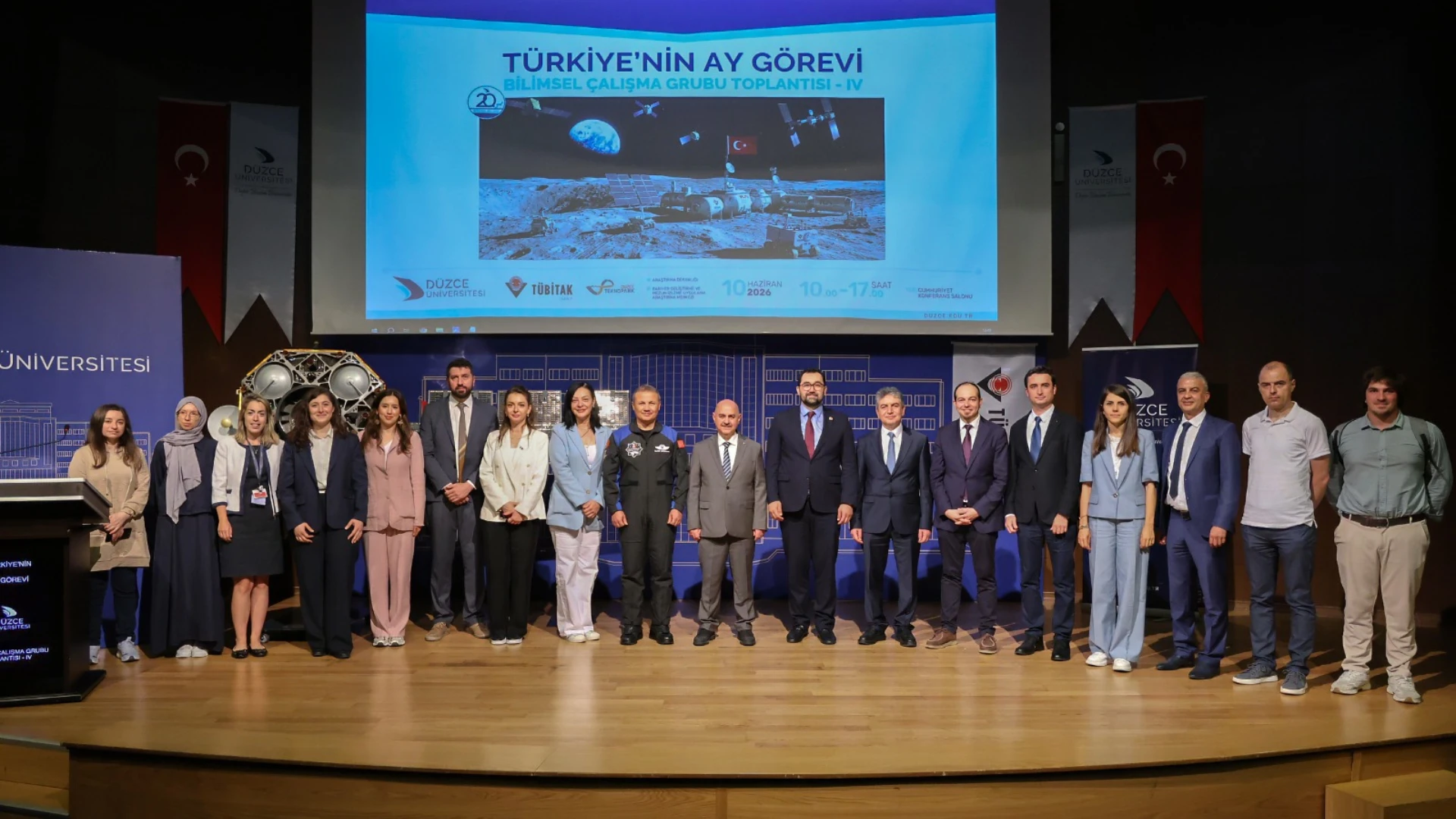
The Turkish Lunar Mission – 4th Lunar Scientific Working Group Summit, organized for the Lunar Research Program and coordinated by the TÜBİTAK Space Technologies Research Institute (TÜBİTAK UZAY), was hosted by Düzce University on Wednesday, June 10, 2026.
The summit addressed the scientific and technological dimensions of the activities carried out within the scope of the Turkish Lunar Mission. It brought together academics, researchers, public institution representatives, and private sector stakeholders to evaluate space technologies, lunar research, scientific payloads, and future collaboration opportunities.
“The Moon Will Serve as an Operational Base for Deep Space Research”
Delivering the opening speech, Dr. Fahri Öztürk, the Lunar Mission Scientific Studies Coordinator at TÜBİTAK UZAY, stated that the Moon serves as a 4.5-billion-year-old scientific archive shedding light on the formation and evolution of the Solar System. Pointing out that lunar research is critical not only for scientific discoveries regarding the Moon itself but also for future deep space missions to be undertaken by humanity, Öztürk evaluated the Moon as a strategic operational base for subsequent deep space targets like Mars. Noting that the spacecraft developed under the Turkish Lunar Mission features an indigenous development percentage of over 80, demonstrating Türkiye’s capability in space technologies, Öztürk emphasized that such events contribute significantly to forming new collaborations and thus strengthening the lunar research ecosystem.
The Space Research Ecosystem Evolving with the Lunar Mission
Following Öztürk’s remark, Mehmet Nefes, the Institute Director of TÜBİTAK UZAY, emphasized that the Turkish Lunar Mission is far beyond being just a deep space mission; it is a major vision project that will advance Türkiye’s scientific, technological, and strategic capacity. Stating that our research in space technologies unite researchers, engineers, and academics from different disciplines around a common goal, Nefes expressed that this will accelerate the growth of Türkiye’s increasingly robust space ecosystem and deepen cooperation among public institutions, the private sector, universities, and research centers. Highlighting the critical role of these collaborations in the mission’s success, Nefes added that the Lunar Mission serves as a source of motivation that will inspire younger generations and boost interest in science and technology. He noted that all the software in the project is indigenous, with three out of six payloads being domestically developed, while the remaining payloads are built with international contributions to allow shared data utilization, emphasizing the project’s vision for national and international cooperation.
In the Footsteps of a 600-Year-Old Dream: Ali Kuşçu Exploration and Mapping Objectives
Nefes stated that Türkiye can reach pioneering targets in space with its strong human resources, advanced research infrastructure, and determined vision, adding that the 3.5-ton lunar spacecraft currently under development represents an unprecedented milestone for the country. Announcing that the spacecraft is scheduled to embark on its journey in 2027, he stated that Türkiye will join the select group of nations capable of executing advanced scientific and technological operations in lunar orbit. Pointing out the historical and cultural significance of Turkish Lunar Mission, Nefes remarked that a nation bearing the crescent and star on its flag, with the crescent being celebrated twice within its National Anthem, holds a deep-rooted heritage that bestows a monumental cultural meaning upon this mission.
One of the core scientific objectives of the mission is to carry forward the legacy of Ali Kuşçu, the renowned astronomer who conducted groundbreaking celestial studies nearly 600 years ago. Under the “Ali Kuşçu Exploration and Mapping Objectives,” the mission aims to acquire critical data on lunar surface, the presence of water, and local magnetic fields. He concluded that this milestone will elevate Türkiye’s international scientific visibility, strengthen the capabilities of the indigenous space ecosystem, and pave the way for more progressive deep space endeavors in future.
Contribution to the National Space Program from Universities
Prof. Dr. Nedim Sözbir, Rector of Düzce University, addressed the importance of universities in generating knowledge and training qualified human resources to support the goals of the National Space Program. Expressing his pleasure in hosting such a vital summit at Düzce University, Sözbir stated that studies in space technologies offer significant research opportunities for universities. Referring to the GEZGİN-1 Earth Observation Satellite Project, developed jointly with TÜBİTAK UZAY and other pioneering space institutions in the country, Sözbir pointed out the importance of universities being actively integrated into the national space ecosystem through such projects. Emphasizing that guiding young researchers toward these fields is crucial for the country’s future scientific and technological goals, Sözbir expressed his satisfaction with the growing number of academic studies focusing on lunar research. Finally, Sözbir underscored Düzce University’s determination to play an active role in this process and contribute to Türkiye’s vision through scientific research and projects in space technologies.
Alper Gezeravcı: “The Turkish Lunar Mission Will Inspire Future Generations”
Türkiye’s first astronaut, Alper Gezeravcı, stated that space missions provide significant gains in scientific research and human resource development, moving far beyond engineering and technology. Emphasizing that young researchers and scientists will play a decisive role in achieving Türkiye’s objectives in the realm of space technologies, Gezeravcı stated that the Turkish nation possesses the knowledge, determination, and capability to succeed in any field it sets its mind to. Noting that the space projects implemented in recent years are among the most concrete indicators of this capacity, Gezeravcı said that the Lunar Mission is progressing resolutely under the coordination of TÜBİTAK UZAY, and that the will to execute a lunar mission, a capability held by only a few nations globally, is of great importance for Türkiye. Expressing that the Spaceport Project will also increase our country’s independence and competitiveness in space, Gezeravcı described the Lunar Mission as an essential milestone that will showcase Türkiye’s scientific and technological capacity, serve as a source of inspiration and self-confidence for future generations, and further strengthen its ambition in the field of space.
The Turkish Lunar Mission within the National Space Program
Following the opening speeches, Bayram Yıldız, Head of the Space Systems, Missions, and Technologies Department at the Turkish Space Agency, outlined the projects carried out under the National Space Program, including the Turkish Lunar Mission. Yıldız also announced that the 77th International Astronautical Congress (IAC 2026) will be hosted by Türkiye in Antalya between October 5–9, 2026. He emphasized that the congress will offer vital opportunities to introduce Türkiye’s space capabilities to the international community and develop new collaborations.
Architecture of Türkiye’s First Deep Space Mission
Dr. Burak Yağlıoğlu, Project Manager of the Lunar Research Program, shared detailed technical and scientific information regarding the Turkish Lunar Mission during his presentation. Touching upon the scientific significance of the Moon, Yağlıoğlu stated that while contributing to fundamental scientific goals, such as inspecting local magnetic fields and acquiring data on lunar surface characteristics and the radiation environment, the project also aims to investigate potential lunar water resources and water formation dynamics, making the mission a candidate for the world’s first lunar water cycle observatory.
Sharing the technological and scientific objectives along with the mission architecture of the Turkish Lunar Mission, Yağlıoğlu provided information on the current status of the developed spacecraft, mission operations, and scientific payloads. Expressing that the data to be obtained through the mission will produce important outputs for both national and international scientific communities, Yağlıoğlu emphasized that this project, as Türkiye’s first deep space mission, will not only enhance our technological capabilities but also lay the groundwork for new scientific discoveries and build a critical knowledge base for future deep space missions. Yağlıoğlu stated that upon the completion of these efforts, Türkiye will become one of the nine countries with a presence on the Moon. He also noted that TÜBİTAK UZAY has undertaken all responsibilities in the project, except for the hybrid propulsion system developed by DELTAV Space Technologies Inc.
Lunar Mission Scientific Payloads
In the subsequent sessions, current studies regarding the scientific payloads being developed for the Turkish Lunar Mission were shared. Among TÜBİTAK UZAY researchers, Burak Karagözoğlu delivered presentations on the Lunar Neutrals Telescope (LNT) and Radiation Calorimeter; Sena Nur Çalışkan on the Lunar Narrow Field of View Radiometer (LNR) and Dosimeter; and Dr. Zeynep Nilüfer Öztürk on imaging payloads.
Academic and Sectoral Contributions
In the final sessions, researchers from various institutions and universities shared their studies and proposals in lunar sciences and space technologies. Within the scope of the presentations, Dr. Cihan Taştan discussed the durability of DNA inspired data storage systems under microgravity and cosmic radiation conditions; Dr. Ahmet Eymen Akşener presented lunar regolith studies on behalf of Prof. Dr. Mehmet Ali Gülgün; and Assoc. Prof. Dr. Ersin Söken shared robotic research on the lunar surface and the CHERI Project. Additionally, Mehmet Batuhan Kaya, Founder of PUURA Space, presented on propulsion systems; Emre Aklan, Founder of TURKUZAYSAN, on landing test vehicles; and Ömer Burak İskender, Founder of Final Proximity, on guidance and control algorithms that play a critical role in landing missions. Global developments were also widely covered in the session: Süleyman Salihler, General Manager of POLIMAK, summarized European and US-centered studies on space resources, while Assoc. Prof. Dr. Mustafa Helvacı introduced a space-based autonomous photometric measurement system for measuring lunar albedo. The session concluded with Yağmur Arzum Kaya’s presentation on landing site selection methodologies, which is highly critical for lunar missions. The summit, which contributed to evaluating the scientific activities conducted in line with the Turkish Lunar Mission and fostering new collaborations, concluded after participants shared their views and suggestions.
In light of these achievements, as TÜBİTAK UZAY, through the activities we conduct under the Lunar Research Program, we will continue to develop the scientific and technological capabilities that will enable Türkiye to achieve its National Space Program goals, while strengthening national and international collaborations.