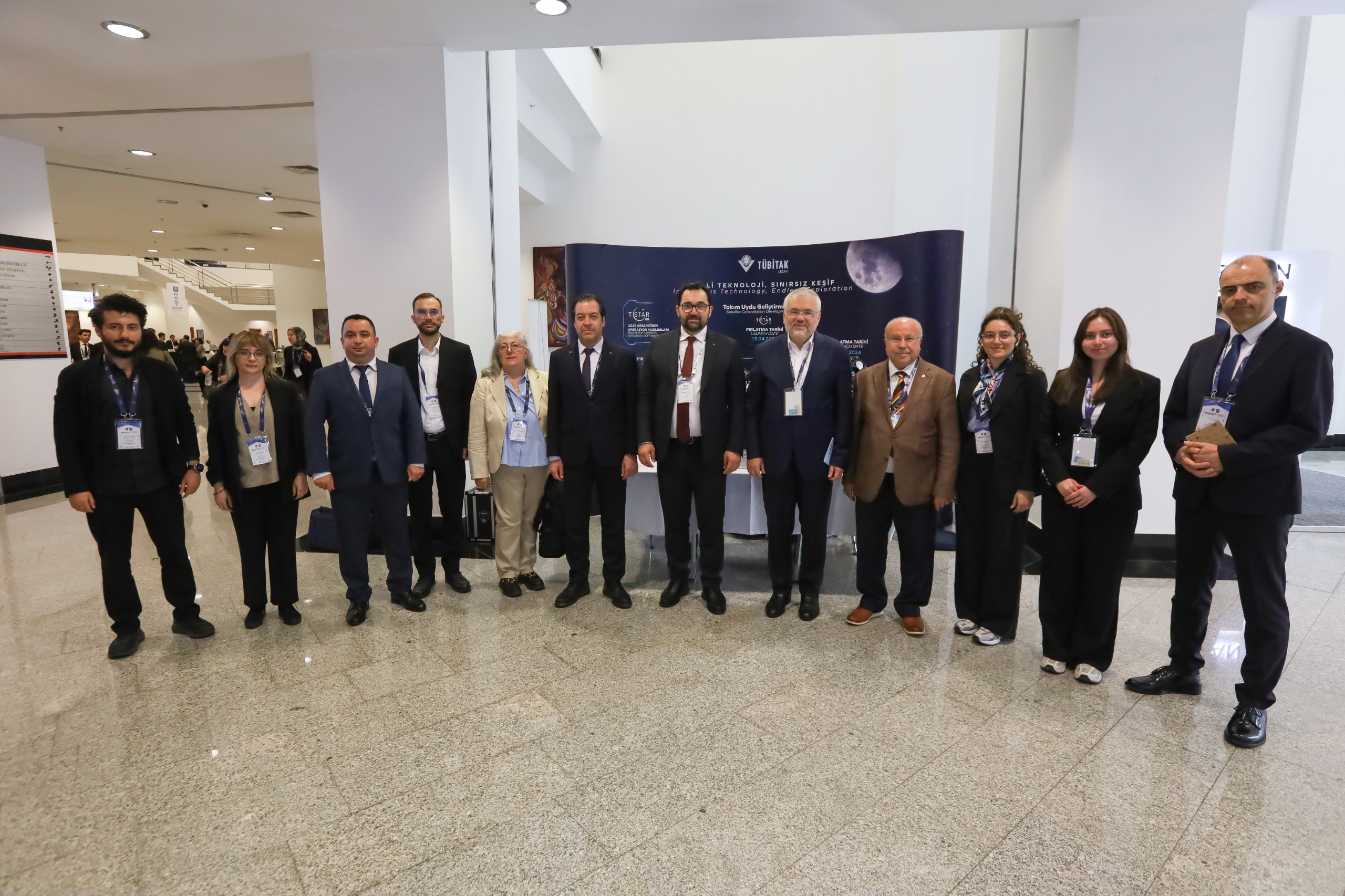

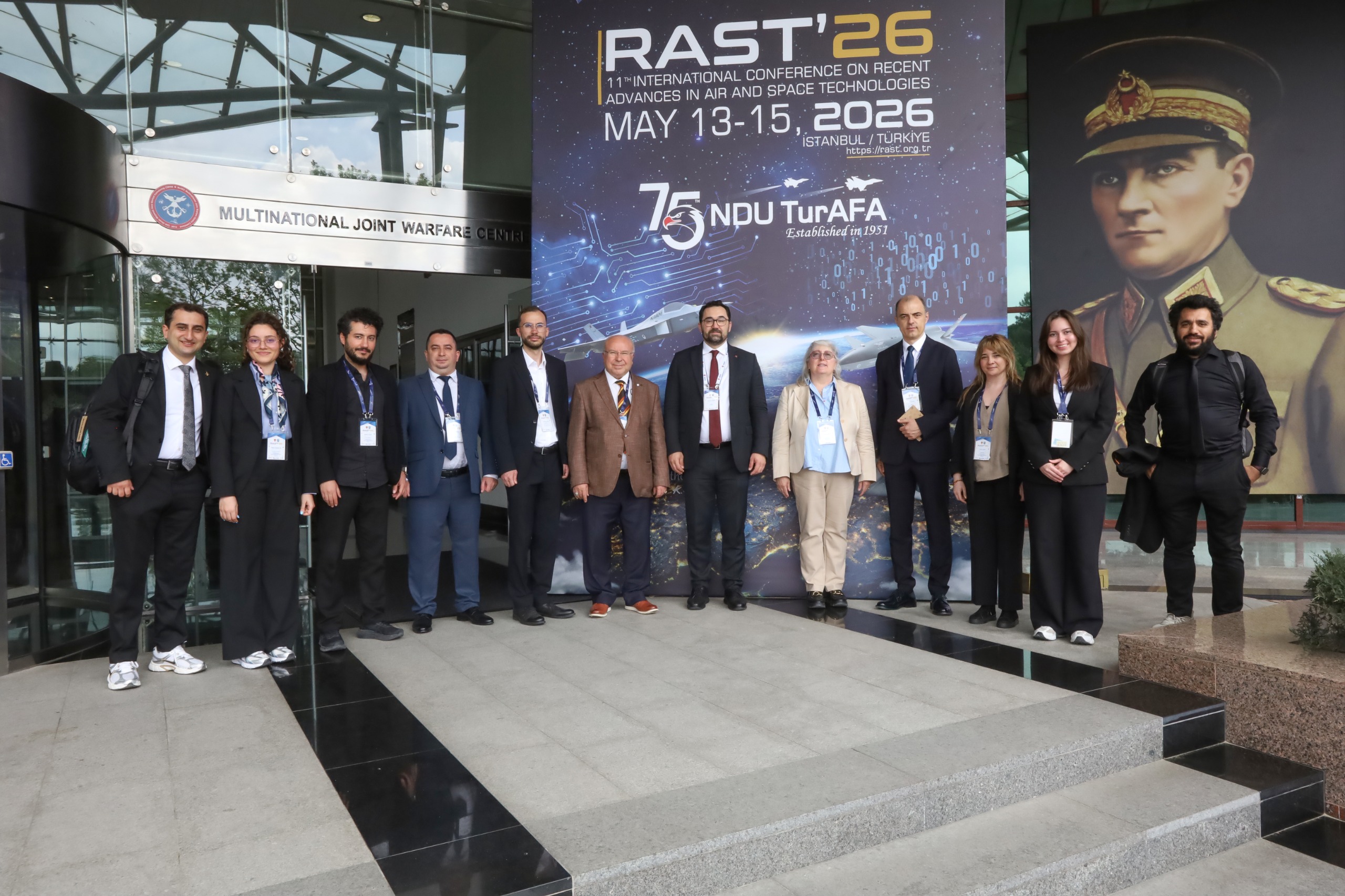
As TÜBİTAK Space Technologies Research Institute (TÜBİTAK UZAY), we took part with a strong presence in the International Conference on Recent Advances in Air and Space Technologies (RAST 2026), held on May 13–15, 2026, and organized biennially at the international level by the National Defence University, Turkish Air Force Academy.
At the conference, which brought together academics, researchers, industry representatives, and experts in air and space technologies from different countries, we had the opportunity to present our competencies in space technologies, our ongoing projects, our engineering capabilities, and our R&D activities to national and international participants.
Within the scope of RAST 2026, a total of 14 scientific papers prepared by our researchers were accepted, and we delivered 12 technical presentations during the conference sessions. Our presentations covered a wide range of topics, including radiation shielding analyses for total ionizing dose effects on satellites in Low Earth Orbit (LEO), machine learning-based preliminary design approaches for Hall effect thrusters, orbit determination studies for Geostationary Orbit (GEO) and lunar missions, deep-space navigation, space weather and atmospheric drag effects, as well as AI-based data processing and satellite analysis.
In addition, we shared our work on optical image simulation for space objects in orbit, sensor fusion methods for deep-space missions, modular and reusable on-board computer architectures for multi-orbit and deep-space missions, and satellite navigation and space situational awareness during the conference sessions.
Throughout the conference, we also introduced our institute’s areas of activity, ongoing projects, and Türkiye’s space goals at our exhibition booth. We provided information on our capabilities in satellite technologies, remote sensing, mission operations, deep-space studies, and national space projects to both national and international participants.
Thanks to the technical presentations, scientific exchanges, and bilateral meetings we conducted during RAST 2026, we had the opportunity to exchange knowledge with international academia and industry representatives, explore potential collaborations, and represent our country’s engineering strength in space technologies on a global platform.
The papers presented during the conference covered a wide range of topics, including comparison of different shielding materials for total ionizing dose effects in LEO satellites, machine learning-based preliminary design approaches for Hall effect thrusters, orbit determination software for Earth- and lunar-orbiting spacecraft, X-ray pulsar-based spacecraft navigation methods, stability and atmospheric decay analyses for the GÖKTÜRK-2 satellite, preliminary mission analysis and design studies for continuous surveillance and early-warning satellite systems, sensor fusion approaches for deep-space missions, data-driven orbit determination methods for GEO satellites, modular on-board computer architectures for multi-orbit and deep-space missions, and synthetic optical image simulation studies for LEO and GEO space surveillance applications.
As TÜBİTAK UZAY, with our wide range of capabilities spanning from satellite technologies to deep-space missions, we will continue to contribute to Türkiye’s National Technology Initiative, develop indigenous technologies, and enhance the international visibility of our country’s capabilities in the field of space.
Our Technical Presentations
Our technical studies presented at the RAST 2026 sessions that reflect our engineering capabilities ranging from satellite technologies to deep-space missions are listed below.
- A Sensor Fusion Approach for Deep-Space Angle-Only Navigation Using sCMOS and Event-Based Camera (Seda Aydın, Şemsettin Numan Sözen, Kürşat Yenidoğan & Rabia Tüylek Tok)
- A Synthetic Optical Image Simulator for LEO and GEO Space Surveillance (Taha Lahaçlar & Aydın Kaya)
- Comparison of Different Shielding Materials for Total Ionizing Dose in Low Earth Orbit Satellites Using SPENVIS, OMERE, and FASTRAD (Terlan Dogan, Sera Iflazoglu & Ilknur Baylakoglu)
- Comparison of Time-Domain Cross-Correlation and FFT-Based Methods for X-Ray Pulsar Phase Estimation in Spacecraft Navigation (Yasin Güngör & Halil Ersin Söken)
- Machine Learning Based Scaling Approach for Hall Effect Thruster Preliminary Design (Betül Kaymaz, Gökay Deniz, Barış Çal & Duygu Çetin)
- Modular and Reusable On-Board Computer Architecture for MultiOrbit and Deep Space Missions (Onur Turhan, Mustafa Ceylan, Coşkun Çelik, Mehmet Oturak, Ahmet Melih Gedikli & Cihan Erzen)
- Numerical Investigation of the Thermal Behaviour of HALE1500 Hall Effect Thruster Developed at Tubitak Space (Gökay Deniz, Duygu Çetin, İlksen Burat, Yusuf Yurttaş, Seda Kayra Güllü, Barış Çal, Mehmet İlbağı & Berk Taşyürek)
- Orbit Determination Software of TUBITAK UZAY for Earth and Lunar Orbiting Spacecraft (Yasin Güngör, Abdülkadir Koker, Aleyna Erdoğan, Enes Dağ, Şahin Ulaş Köprücü & Burak Yağlıoğlu)
- Preliminary Mission Analysis and Design of a Continuous Surveillance and Early Warning Satellite System (İbrahim Doğa Ergin, Enes Dağ, Mustafa Ekinci, Gökhan Kurt, Muzaffer Çetin, Hilmi Sundu, Çağatay Yavuzyılmaz, Barış Çal, Emrah Öncü, Erdinç Mermer, Buğse Beril Arı Kovan, Ayça Kalkan, Mehmet Karahan, Bülent Avenoğlu & Mustafa Mehmet Nefes)
- PRNU Stability Analysis of Gokturk-2 Satellite (Mustafa Teke)
- Space Weather and Thermosphere Density Driven Modeling of Atmospheric Decay at LEO: GÖKTÜRK-2 Case (Arif Gözütok & Ömer Ataş)
- ToF-Based Excitation and Damage Localization in a Steel Plate Using Ultrasonic Guided Waves with Predefined Pseudo-Sensor Triplets (Seyfullah Aktaşoğlu & Görkem Egemen Güloğlu)